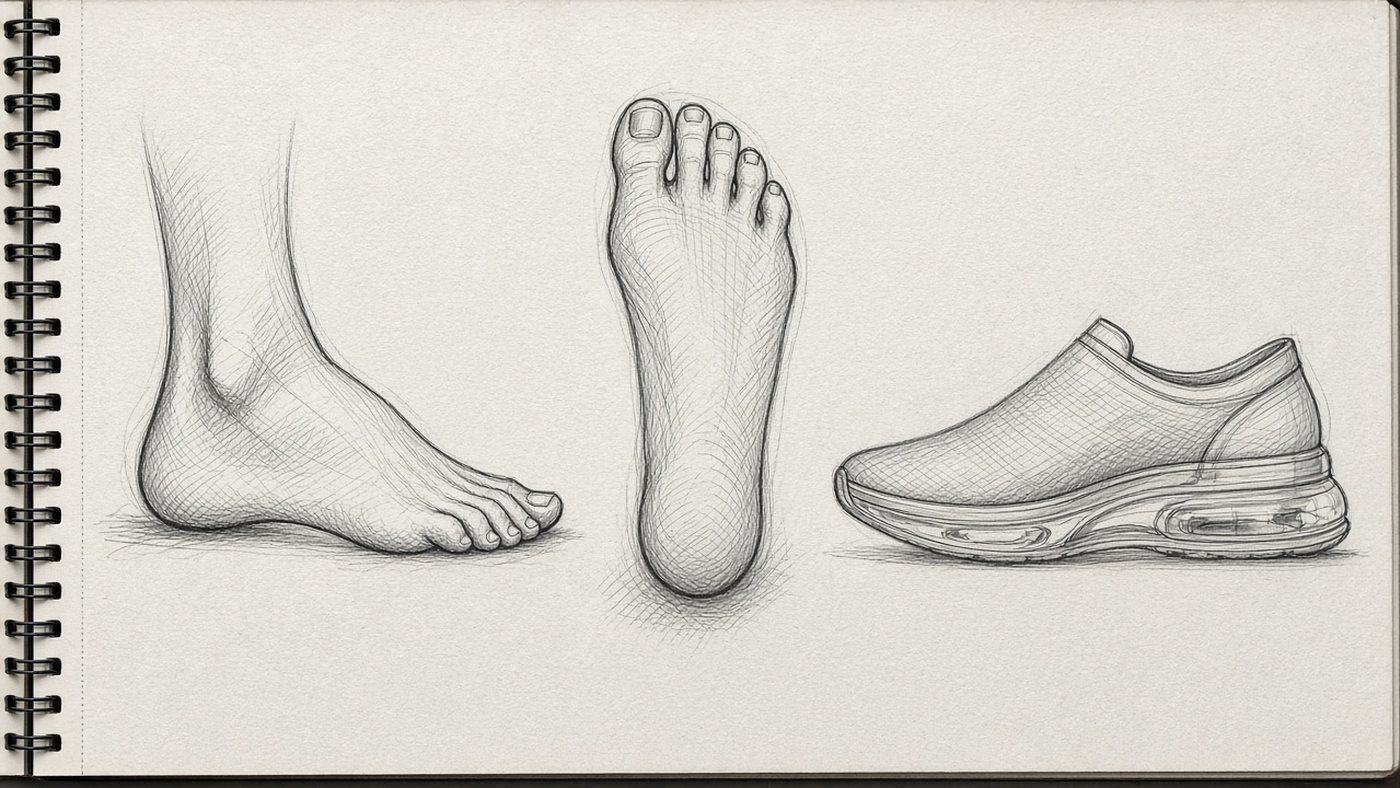
A foot is a wedge
An oval instead of a foot does not stand on a plane: it has no heel and no toes. A foot is a wedge. The heel is narrow and higher, the toes are wider and lower. How that shape sits in the whole figure is in anatomy for artists.
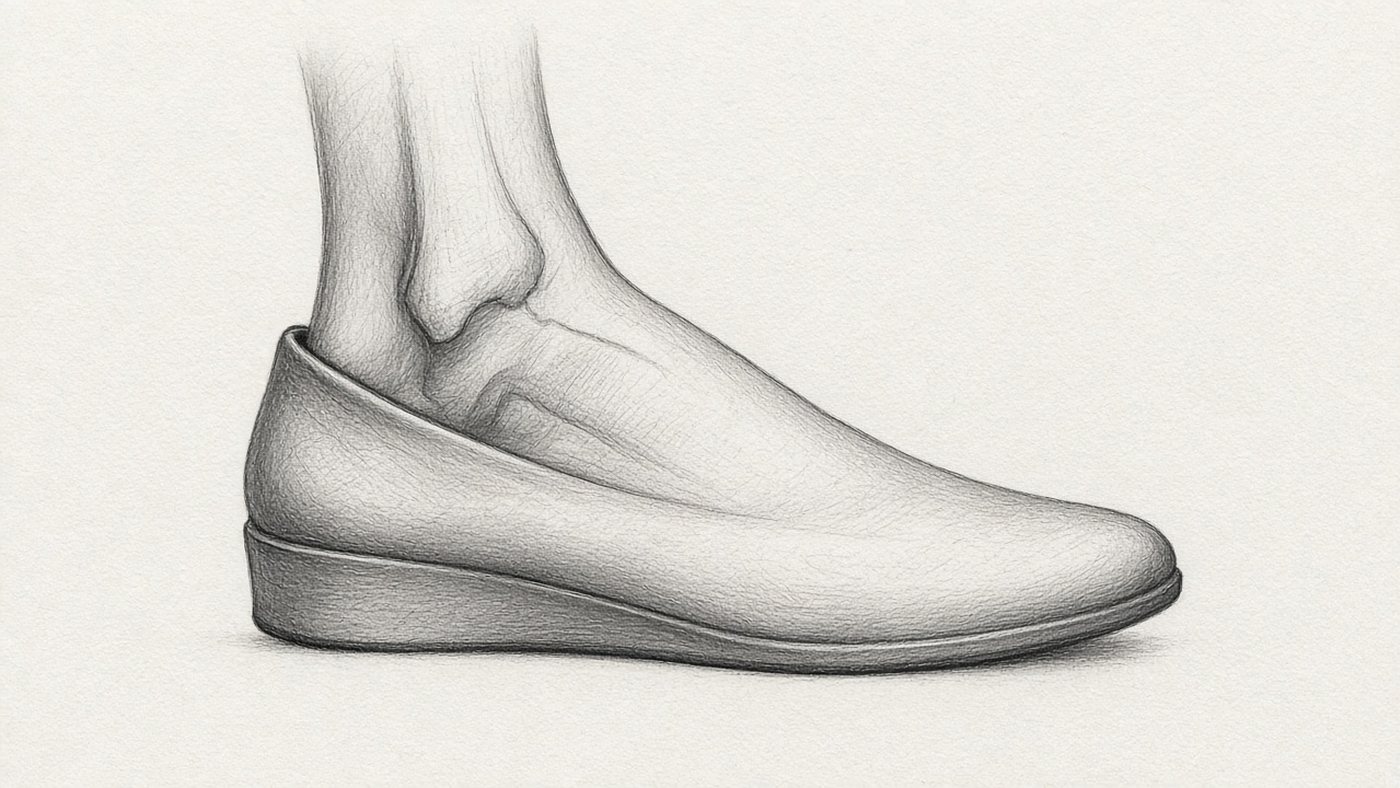
The heel is narrower than the toes
At the back the foot is narrow. At the front it widens into the ball of the toes. Equal width is a block, not a foot. The sole does not touch the ground everywhere: heel, ball, and toes, with the arch slightly lifted between them.
The ankles sit at different heights
The inner ankle is higher than the outer one and a little farther forward. Two dots at one height turn the ankle into a bracelet. Mark them before the shoe. A boot hides them, and the error disappears with them.
- Mark a wedge: narrow heel, wide toes.
- Place the ankles at different heights.
- Mark the instep, the upper arch.
- Break the toes into a staircase, not a comb.
- Check that the sole sits on one floor line.
Side and top
Two views close most of the errors. Foreshortening makes sense only after them.
The instep
The instep is an arch from the ankle to the toes, not a straight roof. On a boot it still reads through the leather: the top of the boot follows that arch instead of running parallel to the sole the whole way.
Toes in a staircase
From above, the big toe is not always the longest, but the toes step down toward the little toe. They do not stand in a row of equal length. The little toe is shorter and higher off the ground in a front view. Those lengths next to the rest of the body are in proportions.
A shoe without every seam
Seams and logos do not make a boot a boot. The sole, the heel, and one crease do.
Sole and heel
The sole is its own thick band, darker than the upper. The heel of the boot sticks back farther than the heel of the foot. If the sole is fused to the upper in one contour, it is a sock, not a shoe.
One crease at the instep
One crease sits where the foot bends, nearer the toes. A bunch of little ticks all over the boot is noise and does not show the bend. A second crease can go at the ankle if the boot is tall.
- A wedge, not an oval.
- The inner ankle is higher.
- The sole is a separate band.
- One crease at the bend, not ten seams.
Check
Lay a ruler along the floor in the drawing. The heel and the ball should touch that line. If only the toes touch, the person is on tiptoe, even if you did not mean it.
A foot in foreshortening
Toes coming toward you hide the length. The wedge is still there. It is only compressed.
Toes toward you
The toes become oval pads. The big toe is closer and larger. Do not draw five long sausages: the length went into perspective. You see the pads and the gaps.
The heel recedes
The heel is smaller and higher on the picture plane if the toes point at you. The ankle sticks up above it. If the heel is the same size as the toes, there is no foreshortening. There is a top view.
Time to draw, not just read
Theory fades in a couple of days if you never use it. Open the editor and spend 15 minutes on what you just read. That is enough for the skill to stick.
Try it now
A free online editor: brushes, layers, a palette, and a shared canvas. No install and no sign-up.
Start drawingTopics in this guide
- how to draw feet
- drawing a foot
- ankles in a drawing
- how to draw shoes
- foreshortened foot
← How to draw an ear that sits on the head Thumbnail sketches before the final drawing →