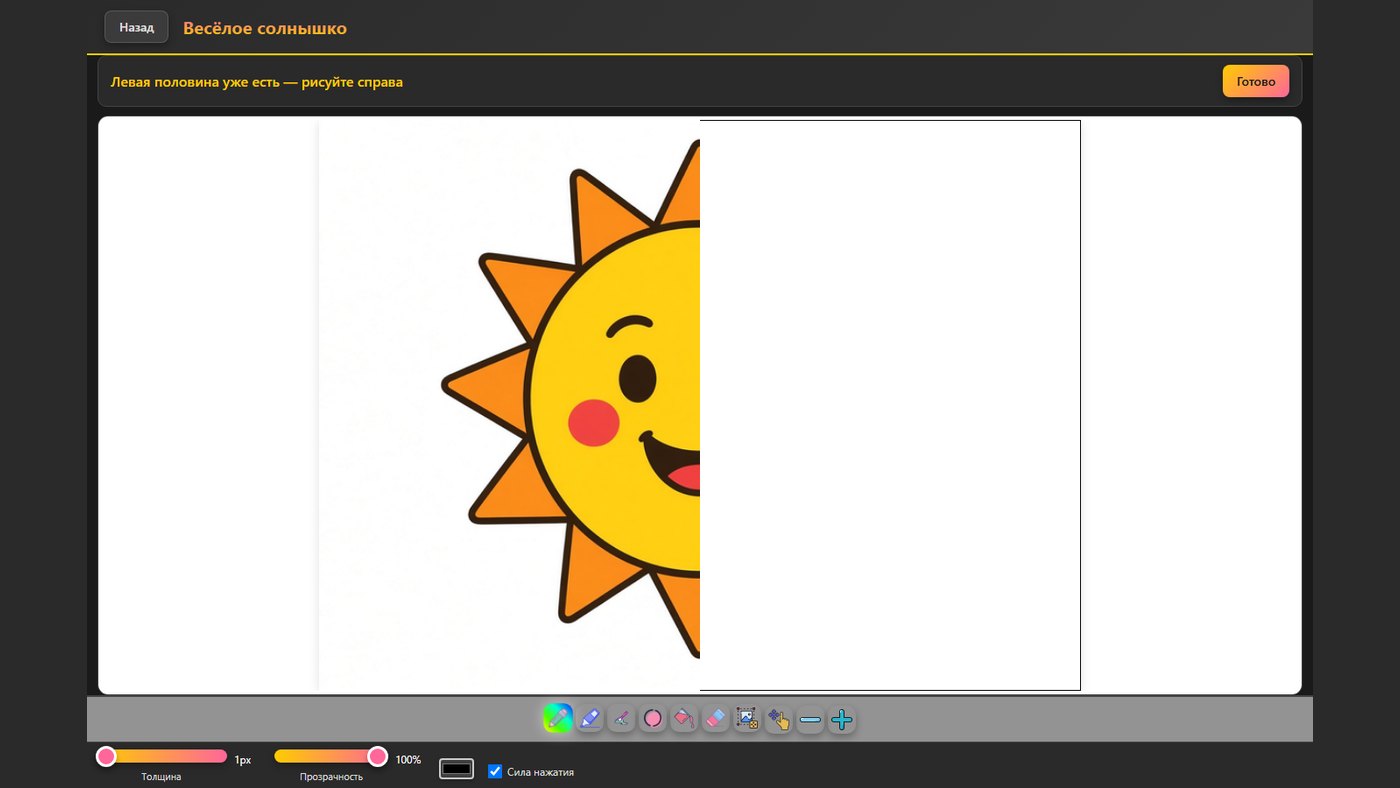
What is already drawn
In finish the drawing half the picture is already on the canvas. It is not a blank sheet and it is not a game for several people. You are handed someone else's start and asked to bring it to one whole thing.
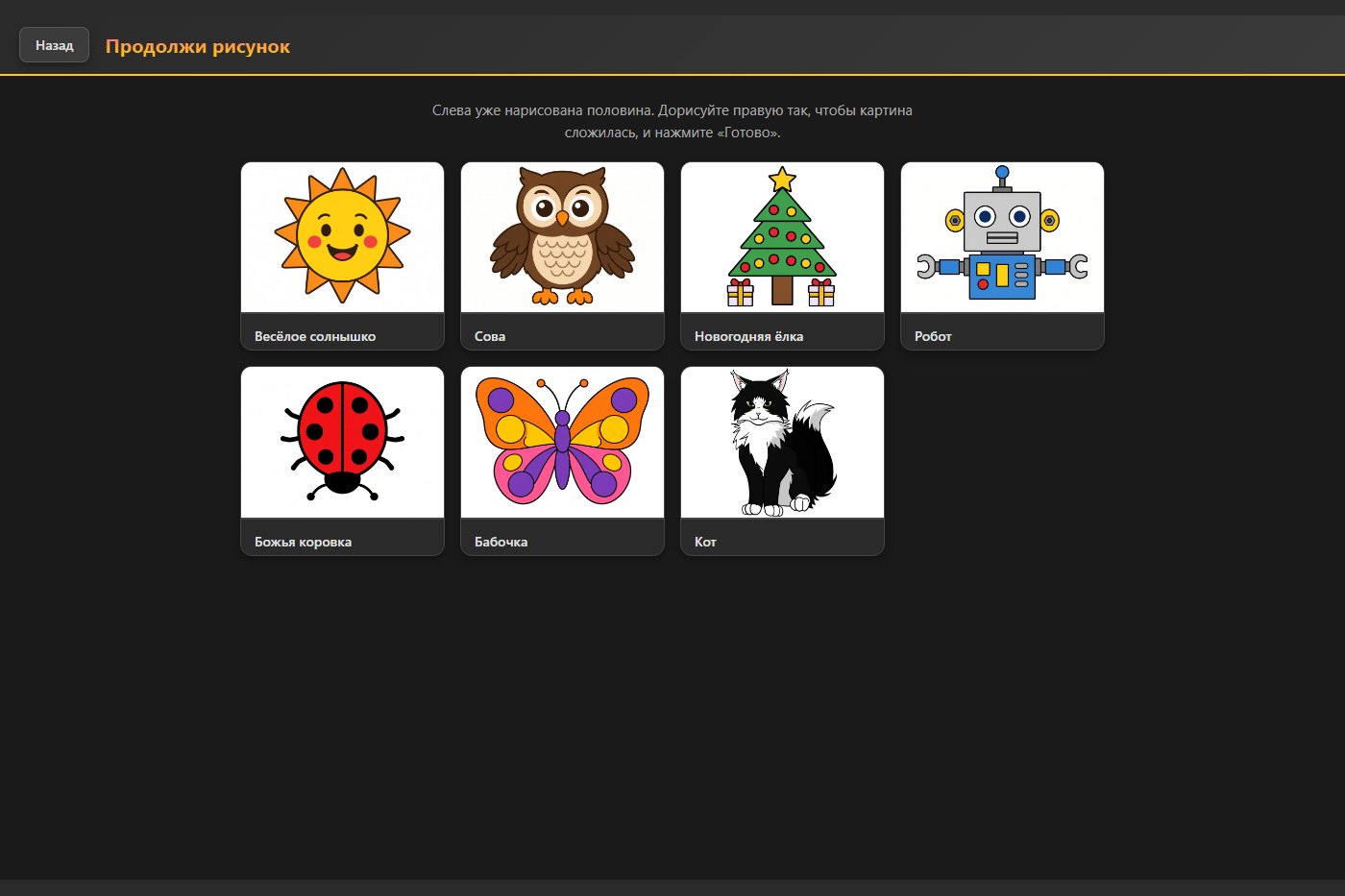
The left half is done
The drawing has begun on the left. You do not erase it and you do not redraw it: it is the condition. The screen says so. The left half is already there, draw on the right. If the left side is a cup, the right side has to continue that cup, not introduce a cat you happen to like today.
The right half is yours
Your canvas is the right side. Line, color, and detail continue what is already visible on the left, so the picture holds as one thing. The join in the middle is the honest place. If thickness or tilt breaks there, the eye sees it before any score does.
How to close the picture
The mode is waiting for a continuation, not a second independent sketch. How to look at someone else's form without tracing it is in the guide on drawing from a reference.
The same thing, continued
If the left side is a cup, the right side gets the handle, the ellipse, and the same shadow. A new object in the right corner breaks the task. The score later compares you with the right half that was intended, not with whether the result feels interesting.
The Done button
When the right side holds together, press Done. Until that button, nothing is scored, so you can still move an edge while you can see that it has not sat down. After the button the mode goes to the result.
- the left half is already drawn, and you do not redo it;
- you draw on the right, into the same thing;
- the join in the middle has to hold thickness and color;
- Done sends the sheet to be scored;
- how the drawing was meant to look appears after the count.
What the mode scores
The mode scores how close your continuation is to the original. "I think it works" does not enter that screen. While the count runs, it says it is counting. The number arrives with the result, not during a stroke.
Similarity to the original
The caption on the number is plain. A high result is almost as intended. A middle one means the continuation is recognizable. A low one means it is not much like the right half yet. This is not a grade for how well you draw in general. It is a comparison with one covered half.
After Done
The number arrives together with how the drawing was meant to look. While you are still drawing the line, there is no score.
How it was meant to look
Next to your right half, the original is shown. That is where you see the hand leave: a different tilt, a different tone, an extra object. You can run the task again or open another one once that is clear.
What it trains
The useful skill here is reading someone else's form through to the end, not replacing it with your own from zero. The left half has already made the decisions. The right half continues them.
Reading someone else's form
Tilt, thickness, and color are already on the left. If the left tone is dark and you put an open white on the right, the picture does not hold. The comparison with the original shows that at once, without a long critique.
Not starting a new subject
A second object, a different light, "I would rather draw my own" is no longer a continuation. For a full reference, step by step, there is trace the drawing. Here half is covered on purpose, so the hand learns to finish a form instead of starting over.
- Open a task and look first at what is already on the left.
- Notice the tilt, the thickness, and the color of that half.
- Draw the right side into the same thing.
- Press Done when the join no longer bothers you.
- Compare your half with how the drawing was meant to look.
Time to draw, not just read
Theory fades in a couple of days if you never use it. Open the editor and spend 15 minutes on what you just read. That is enough for the skill to stick.
Try it now
A free online editor: brushes, layers, a palette, and a shared canvas. No install and no sign-up.
Start drawingTopics in this guide
- finish the drawing
- draw the other half
- similarity to the original
- right half of a drawing
- drawing game mode
← Trace the drawing: steps and a similarity score One canvas for all: strips that stay hidden until the reveal →