
Short games on one canvas
A short game beats a long “let’s make a masterpiece.” It has an ending, and nobody freezes on someone else’s line. How to open the room itself is in the guide on drawing together on one canvas.
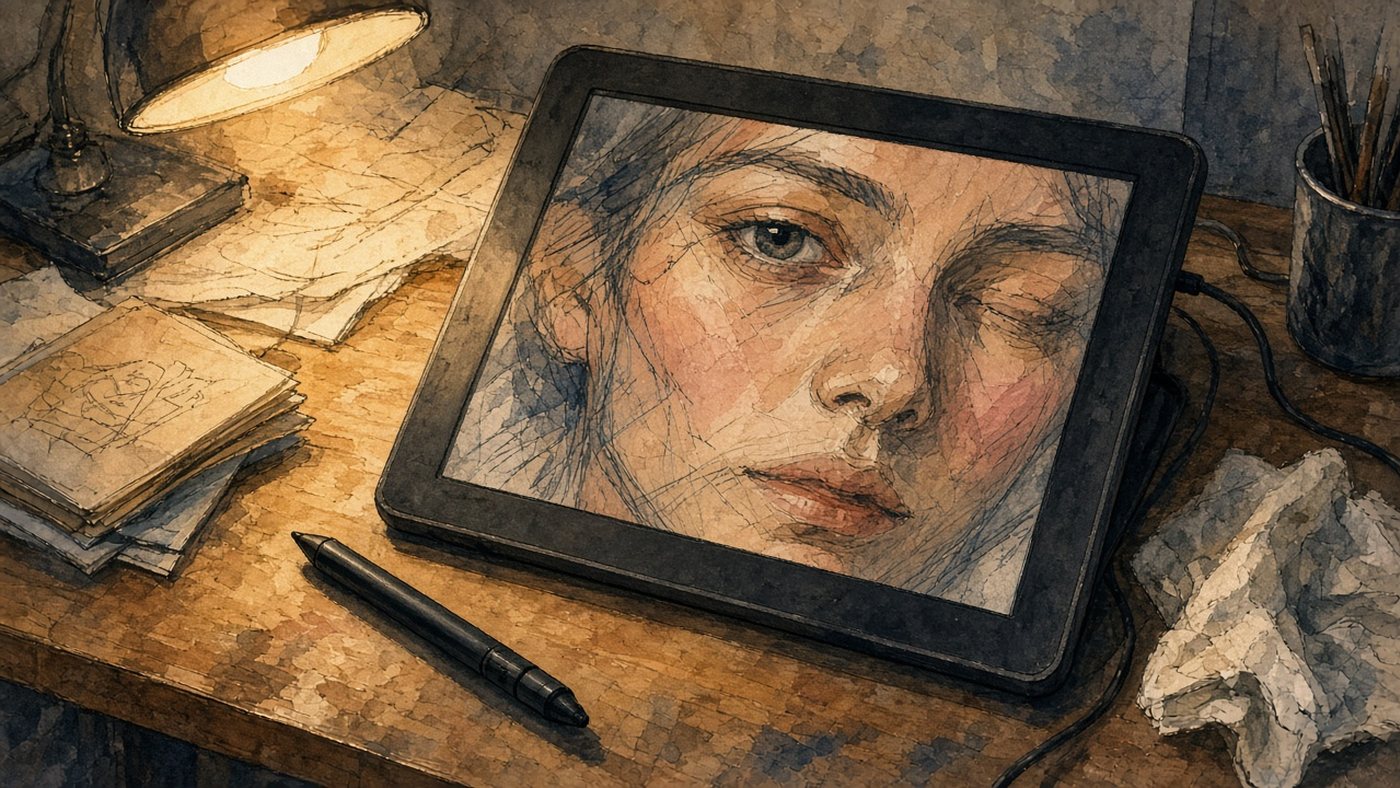
A one-minute relay
Set a 60-second timer. The first person puts down a shape or a contour. The second person has to continue that mark, not start a new drawing beside it. Then the first person goes again. Five rounds, and the canvas is no longer empty. One rule: do not erase the previous turn, even if it looks strange.
Finish what the other person started
One person draws half of an object and looks away for a minute. The other person completes the symmetry, or breaks it: the mug grows a second handle, the house grows an eye. Then you both look. It is almost always funny, and you can see who reads the form and who draws “the usual way.”
- Pick one object, not a whole scene.
- The first person draws for exactly one minute.
- The second person continues without starting a new object beside it.
- Swap two more times.
- Save a PNG before anyone “fixes everything.”
Subjects that do not fall apart
A subject for two people has to split into zones. “A nice landscape” does not split: both of you climb into the sky. A room and a map split on their own.
A room with a window
One person draws the walls, the floor, and the window. The other fills it: a chair, a cat, a plant, whatever is outside. The boundary is obvious. If you argue, the floor and walls stay with the first person, and anything you could carry out of the room belongs to the second. Shared-canvas habits are in the guide on drawing together online.
A map of an invented city
A rectangle fills the canvas, with blocks inside. Each person gets two blocks and draws streets, signs, and one odd thing: a bridge to nowhere, a house shaped like a boot, a bus stop with no road. The only shared marks are the map frame and the city name, written by whoever finishes first.
- A 60-second relay, when everyone is shy about starting.
- Finish the half of an object someone else began.
- One object for two people, when you want a calmer result.
- A room with a window: one person builds the box, the other furnishes it.
- A city map, when there are three or four people.
- Portraits of each other from a chat description, with no photo.
- A shared still life: each person adds one object to the table.
- Animal silhouettes in two minutes, then label someone else’s.
- A three-panel comic: setup, mistake, ending. One panel per person.
- One color for everyone, plus a single accent chosen by the host.
When more than two people join
With three people an empty canvas falls apart faster. You need zones, or everyone draws in the center and the edges stay white.
Zones on the canvas
Divide the canvas into strips or squares with a light line on the bottom layer. Each person gets a strip. The boundary line is erased or hidden later. You enter someone else’s strip only when they ask: “add a tree at my edge.”
A shared background and personal details
One person paints the sky, the floor, or the background color. The others do not repaint it. They place their own objects on top, each on a separate layer. The picture looks like one piece even though several hands made it.
If you stall
Do not hunt for an eleventh idea. Run a five-minute relay. A timer fixes an empty canvas better than a chat debate.
Time to draw, not just read
Theory fades in a couple of days if you never use it. Open the editor and spend 15 minutes on what you just read. That is enough for the skill to stick.
Try it now
A free online editor: brushes, layers, a palette, and a shared canvas. No install and no sign-up.
Start drawingTopics in this guide
- ideas for drawing with friends
- what to draw together online
- shared canvas games
- drawing challenge for two
- collaborative drawing ideas
← Draw together online: one canvas on two computers How to draw people with a mouse: figure and face →