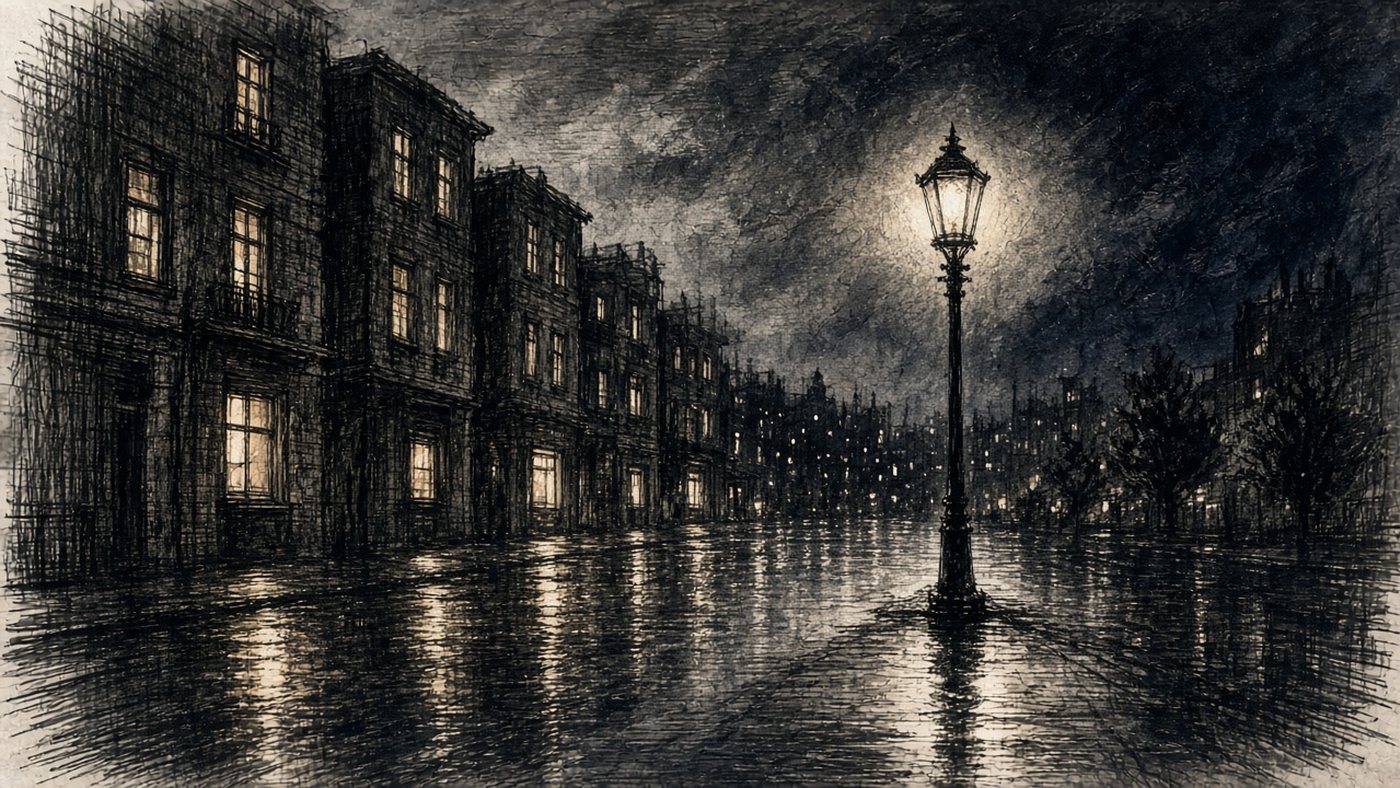
Night starts from the dark
Do not start a night city with a black rectangle. There is nowhere darker to go, and a window cannot light up: it is only a hole in the paint. Start with a middle dark for sky and walls, then what is lighter and darker than that. How the architecture works in daylight is in how to draw cities.
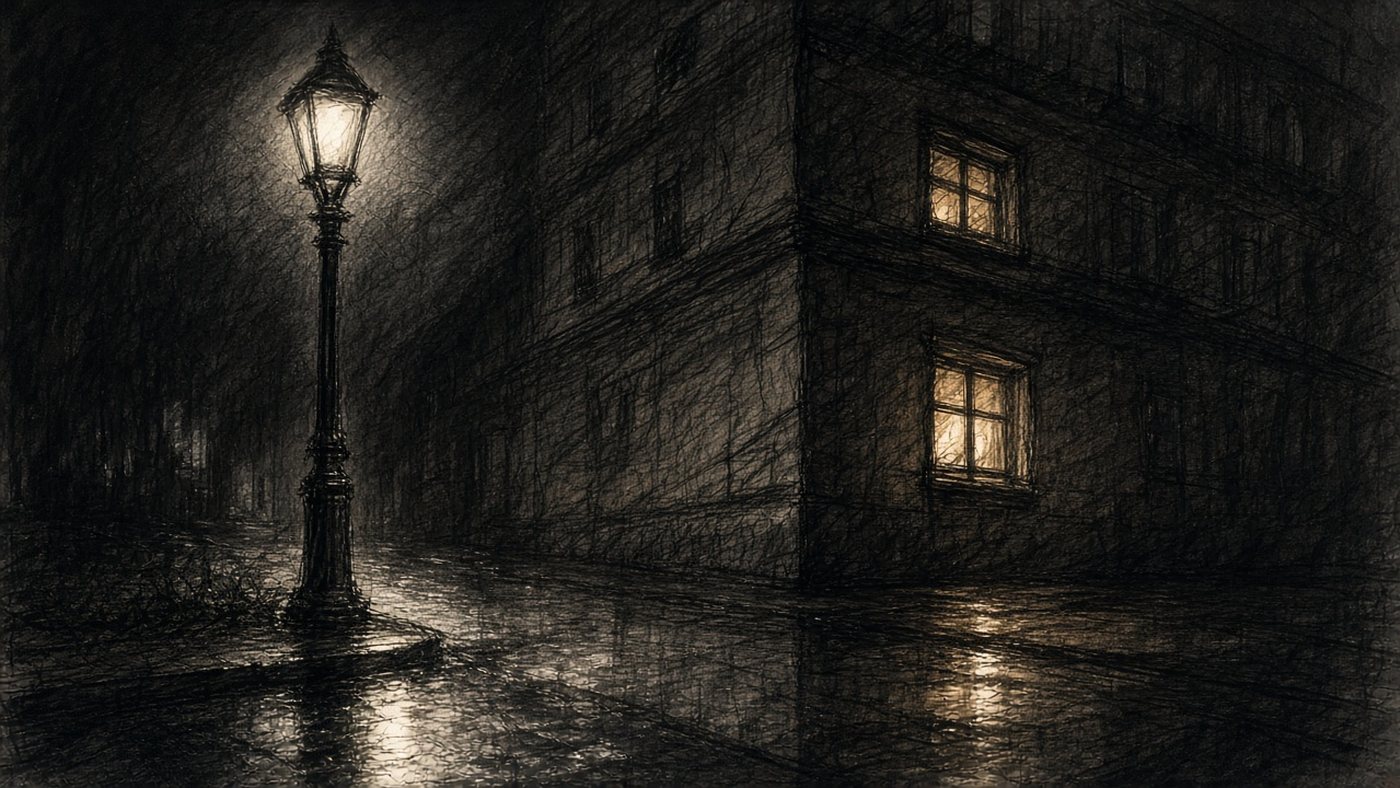
The sky is not black
Even with no moon the sky is a little lighter than the silhouette of the roofs. Otherwise the roof does not separate from the air and the city becomes a cutout. Leave the sky darker than the paper but lighter than the darkest roofs. The difference is small. It is enough.
The lightest note is a window or a lamp
The lightest shape on the sheet is one, or two: a lamp, a shop window, the moon. A facade cannot be equally light, or there is no night. If ten windows are all whiter than the paper around them, the scene is daytime again, only blue.
- Cover sky and walls with a middle dark.
- Make the roofs a little darker than the sky.
- Place one brightest light.
- Keep the other windows quieter than that light.
Windows and lamps
A window at night is a warm patch in a cool wall, not a grid of mullions.
Warm light in cool air
Lamps are warmer than the air. Even in pencil you can show it with density: the window is light and sharp, the air around it is soft and a little bluer if you have color. One cool lamp is fine as an exception, not as the whole city. Light and shadow in general are in light and shadow. Here the source is just small.
Not every window is on
Dark windows are what make the lit ones readable. A row of identical yellow squares is a chart, not a house. Turn a third of them off. On some, leave only a gap in the curtain.
Wet pavement
Wet pavement at night is valued for reflections. They do not copy the sign straight down.
Vertical lights lie down as horizontals
A lamp is vertical. Its reflection in a puddle is horizontal dashes of light, longer when the street is wetter and your eye is lower. A vertical candle of reflection happens only in a very still puddle, and even then it is shorter than the pole.
Short strokes
The stroke is shorter than the width of the street. Dark pavement remains between the strokes. A solid yellow band across the bottom of the sheet is a road marking, not a reflection. Closer to you the stroke is wider and rarer.
- The sky is lighter than the roofs but darker than the paper.
- One main light, the rest quieter.
- Some windows are off.
- Reflections are horizontal and broken.
Check
Find the lightest place. If it is the sidewalk or a wall rather than a light, the night is not assembled yet. Darken the facade and leave the brightness to the lamp.
Silhouette instead of detail
At night there is less detail than in the day. That is not poverty. It is the condition.
Distant buildings are one mass
A distant block is one comb of roofs with rare windows. Those windows are smaller and duller than the near ones. A cornice, a chimney and brick on a far building do not read, and you do not draw them. If the street recedes, perspective is built as usual, see perspective, only in a darker key.
People are dark shapes
A passer-by at night is almost a silhouette. The face is invisible unless the person stands under the lamp itself. Height, a lean, and legs that are darker or slightly lighter than the pavement are enough. Not a portrait. A fully lit person with no light source nearby looks cut out of a daytime photo.
Time to draw, not just read
Theory fades in a couple of days if you never use it. Open the editor and spend 15 minutes on what you just read. That is enough for the skill to stick.
Try it now
A free online editor: brushes, layers, a palette, and a shared canvas. No install and no sign-up.
Start drawingTopics in this guide
- night city drawing
- how to draw night
- windows at night
- wet pavement
- cityscape at night